 Türkçe
 English
 العربية
 Deutsch
Industrial Emission Limits Reference: Türkiye, EU, Germany
Important: This page is a reference summary. Your binding emission limit is set plant-specifically in your environmental/emission permit, and regulations can change. The figures below are taken from the regulations in force; always verify against the current regulation and your permit before any investment decision.
How emission limits are set
Türkiye — SKHKKY: the Regulation on Control of Industrial Air Pollution (first published 3 July 2009, Official Gazette 27277; amended through 2020). It governs stack and area emissions from industrial/energy plants; limit values are given in Annex-1. Air emissions are assessed against this regulation when a plant obtains its environmental permit under Environmental Law 2872.
European Union — IED: the Industrial Emissions Directive (2010/75/EU). Two logics apply: (1) for most sectors (cement, large combustion plants) the limit is a RANGE called a BAT-AEL — the competent authority assigns a plant-specific value within that range; there is no single "EU limit". (2) For waste incineration plants the limits are fixed values in Annex VI (table below).
Germany — TA-Luft (2021): an administrative regulation under the Federal Immission Control Act (BImSchG), binding on permitting authorities; it transposes the EU IED / BAT conclusions into national practice.
Türkiye — SKHKKY selected dust and gas limits
Note: SKHKKY has no single "general dust" constant; general dust uses a graph (Diagram 1) in Annex-1. The dust values below are for the specific process and particle size stated and cannot be used as a general limit.
| Pollutant / process | Limit | Condition (source) |
|---|---|---|
| Dust — crushing/screening/conveying/grinding, particle ≥ 5 mm (fixed + enclosed) | 200 / 150 / 100 mg/Nm³ | for ≤1.5 / 1.5–2.5 / ≥2.5 kg-h flow (Annex-1 b/2.1) |
| Dust — particle 1–5 mm (enclosed) | 75 mg/Nm³ | Annex-1 b/2.2 |
| Dust — particle < 1 mm | 75 mg/Nm³ | Annex-1 b/2.3 |
| Special inorganic dust — Class I (e.g. As, Hg compounds) | 0.20 mg/Nm³ | ≥ 1 g-h (Annex-1 g) |
| Special inorganic dust — Class II | 1 mg/Nm³ | ≥ 5 g-h (Annex-1 g) |
| Special inorganic dust — Class III | 5 mg/Nm³ | ≥ 25 g-h (Annex-1 g) |
| Gaseous inorganic chlorine compounds (Cl⁻) | 30 mg/Nm³ | ≥ 0.3 kg-h (Annex-1) |
| Gaseous inorganic fluorine compounds (F⁻) | 5 mg/Nm³ | ≥ 0.15 kg-h (Annex-1) |
Source: Regulation on Control of Industrial Air Pollution (SKHKKY), Annex-1 (mevzuat.gov.tr).
EU — waste incineration (IED Annex VI) daily-average limits
These values are fixed EU-wide (unchanged since 2010) and standardized to 11% O₂:
| Pollutant | Daily average |
|---|---|
| Total dust | 10 mg/Nm³ |
| Total organic carbon (TOC) | 10 mg/Nm³ |
| HCl | 10 mg/Nm³ |
| HF | 1 mg/Nm³ |
| SO₂ | 50 mg/Nm³ |
| NOx (as NO₂) | 200 mg/Nm³ (new / > 6 t-h) · 400 (existing ≤ 6 t-h) |
| Mercury (Hg) | 0.05 mg/Nm³ (sampling-period average) |
| Cadmium + Thallium (Cd + Tl) | 0.05 mg/Nm³ |
| Other heavy metals sum (Sb, As, Pb, Cr, Co, Cu, Mn, Ni, V) | 0.5 mg/Nm³ |
Source: Directive 2010/75/EU (IED), Annex VI Part 3.
Cement and large combustion plants: the EU gives no single number here; the limit is assigned plant-specifically within the BAT-AEL range of the sector's BAT conclusions. Your exact value is set by the permitting authority.
Germany — TA-Luft 2021 general dust (Gesamtstaub)
| Condition | Limit |
|---|---|
| Mass flow ≤ 0.40 kg-h | 20 mg/m³ |
| Mass flow > 0.40 kg-h | 10 mg/m³ |
| Absolute ceiling (in all cases) | 0.15 g/m³ (150 mg/m³) |
Source: TA-Luft 2021, Nr. 5.2.1 "Gesamtstaub". Other parameters (SO₂/NOx/HCl…) are set separately by sector and BAT conclusions.
Which DUCON technology for which limit?
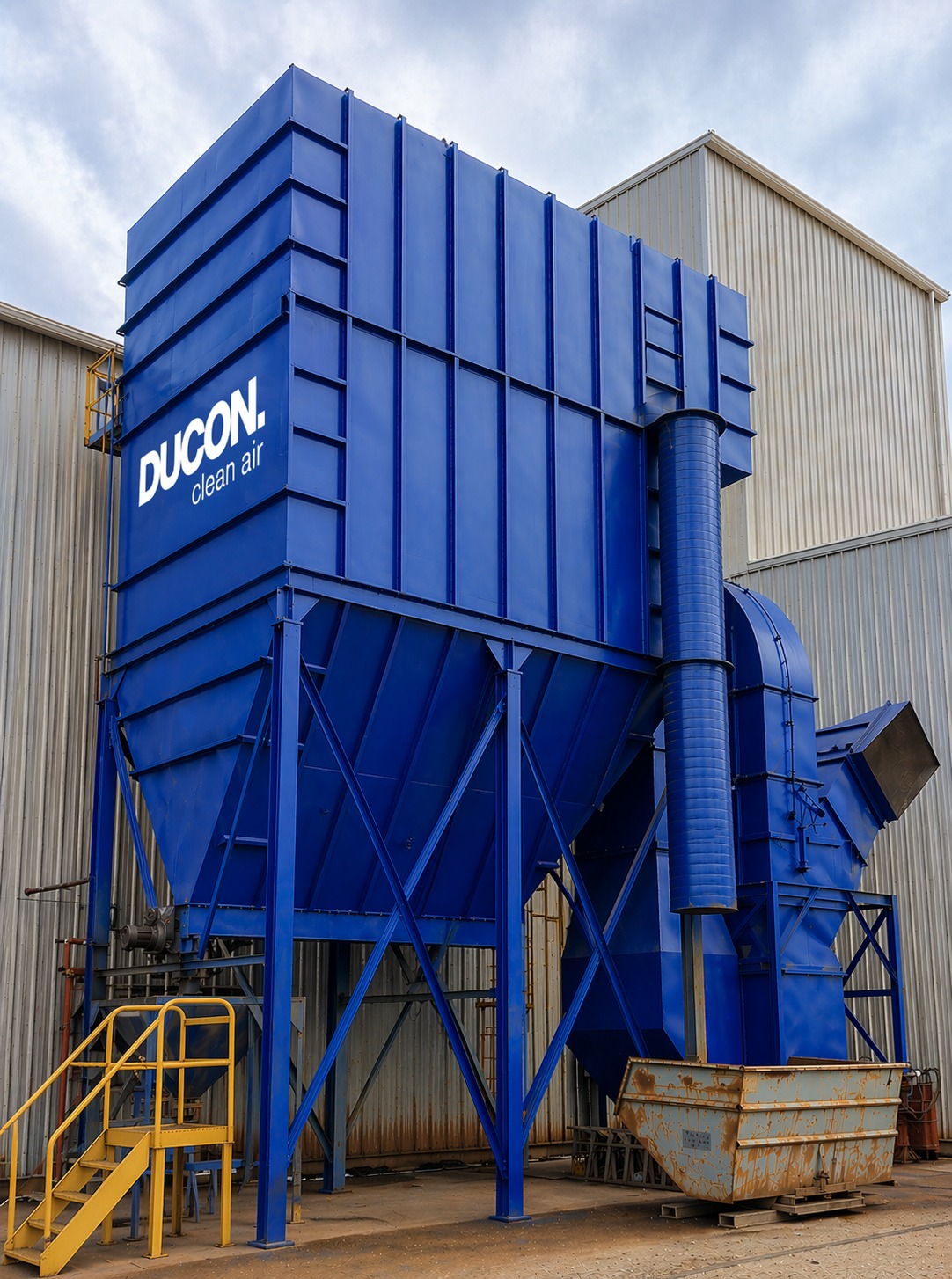
- Dust / particulate → baghouse filter, cartridge filter.
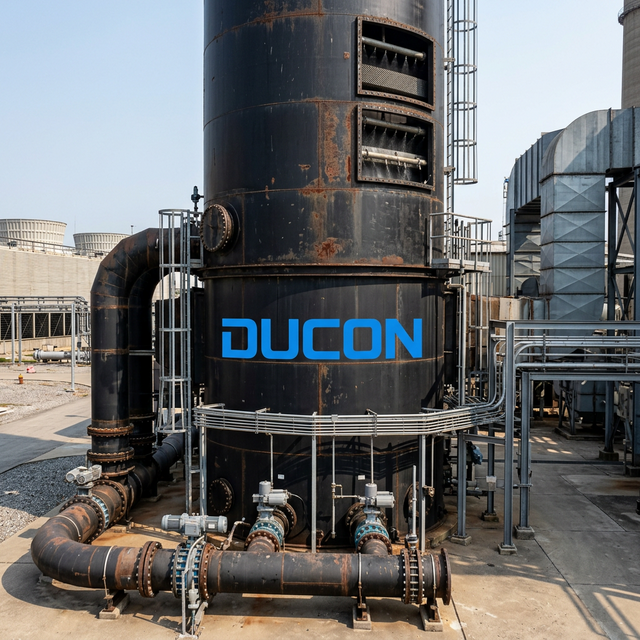
- SO₂ / sulfur → DeSOx / dry sorbent, wet scrubber.
- NOx → DeNOx (SNCR / SCR).
- HCl / HF / acid gas → acid-gas removal, venturi scrubber.
- Mercury / dioxins / VOC → activated carbon.
Let's determine the right solution for your limit together
Since 1986, MDSJ Process (DUCON) has designed, manufactured, and turnkey-installed systems that bring flue gas into compliance with the applicable emission limit. To clarify which limit applies to your plant and which technology is required, contact us. Related guides: baghouse vs wet scrubber guide, glossary.
Disclaimer: the values above are reference information compiled from the regulations in force; the binding emission limit applied to your plant is set by your environmental/emission permit and the current regulation. Regulations change — always rely on the current official text and the competent authority.