
Skip to content
Wet Scrubber

Wet Scrubber

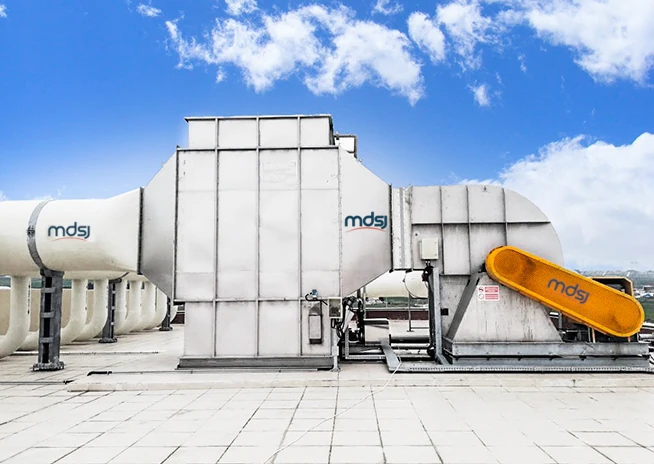
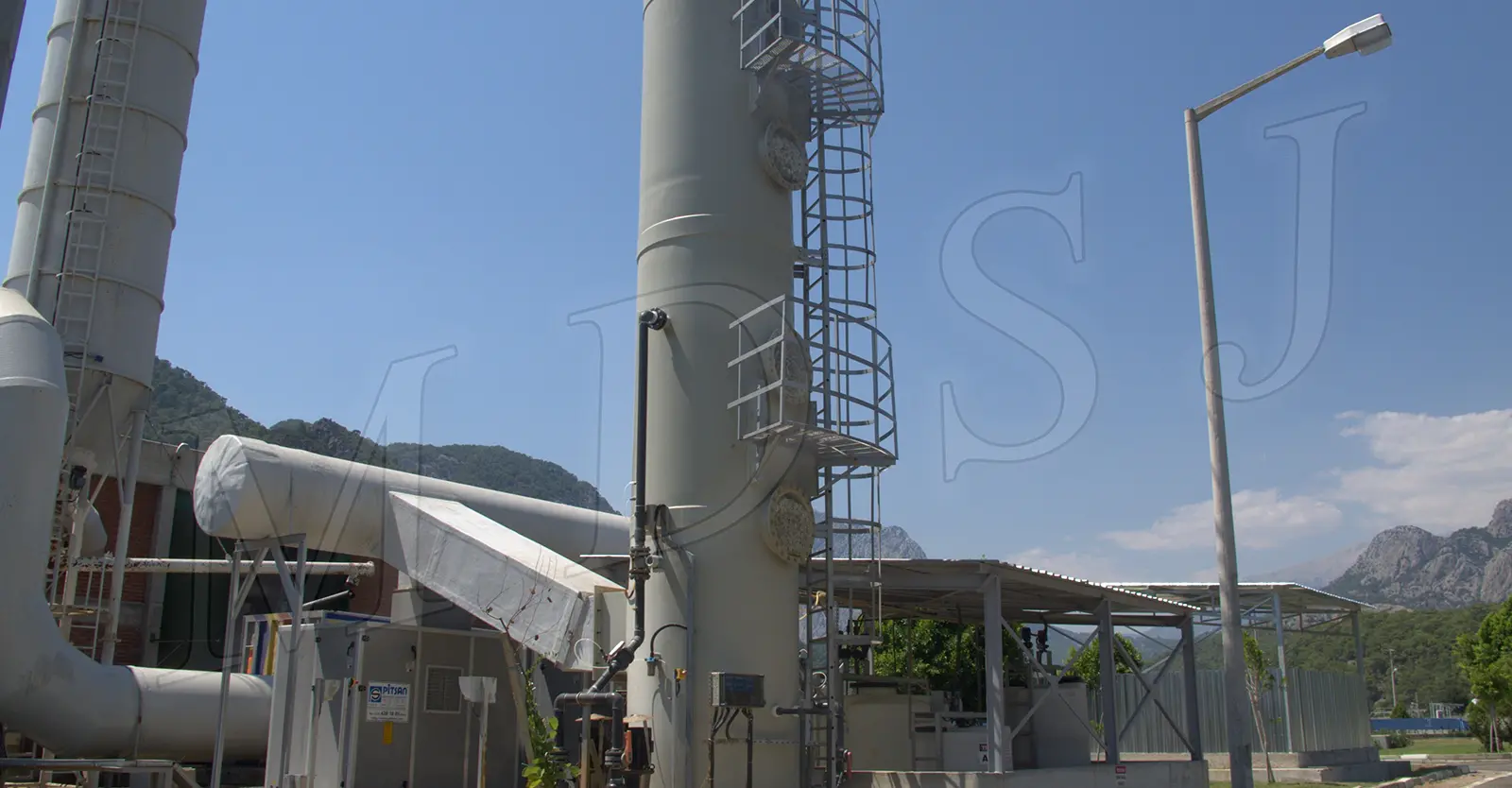
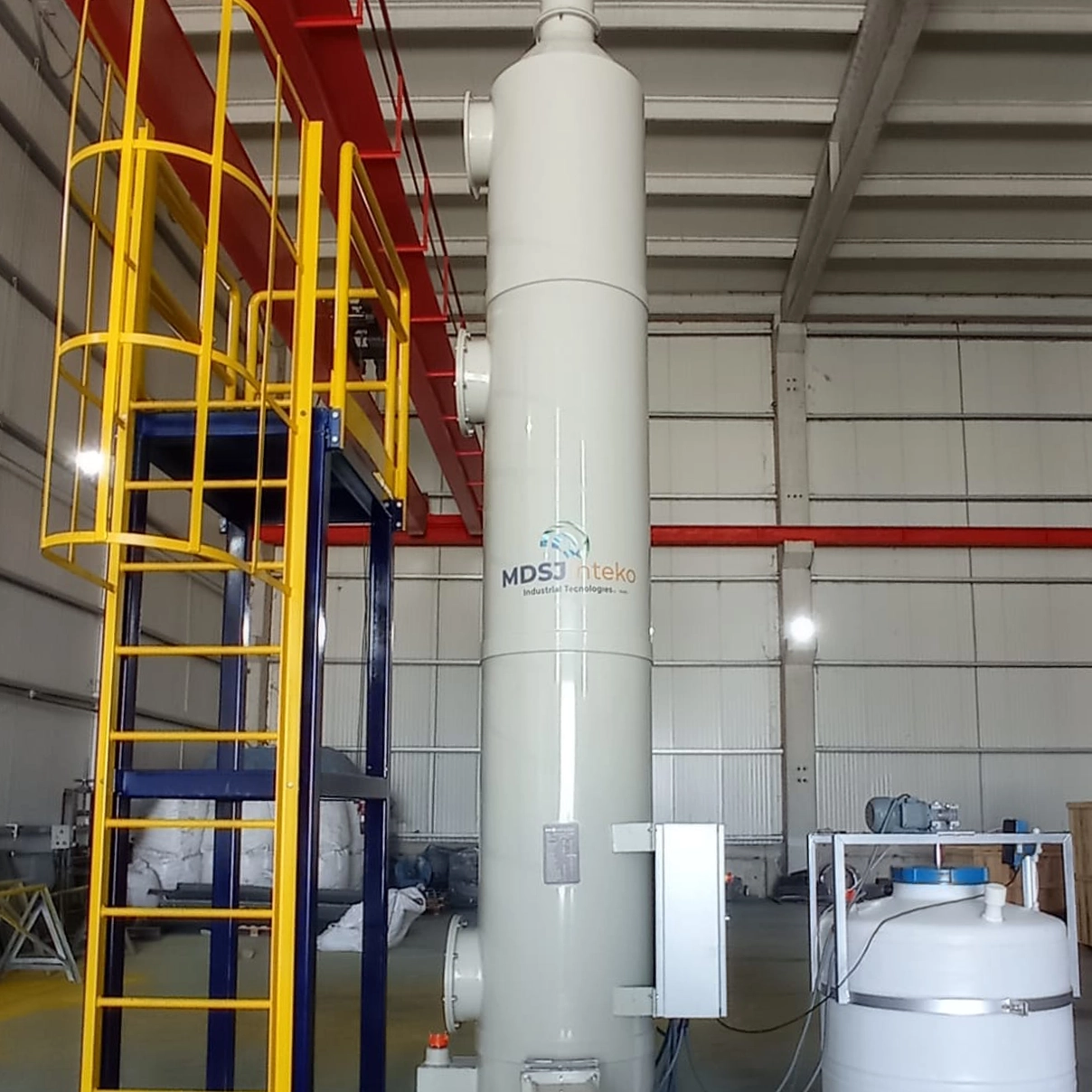
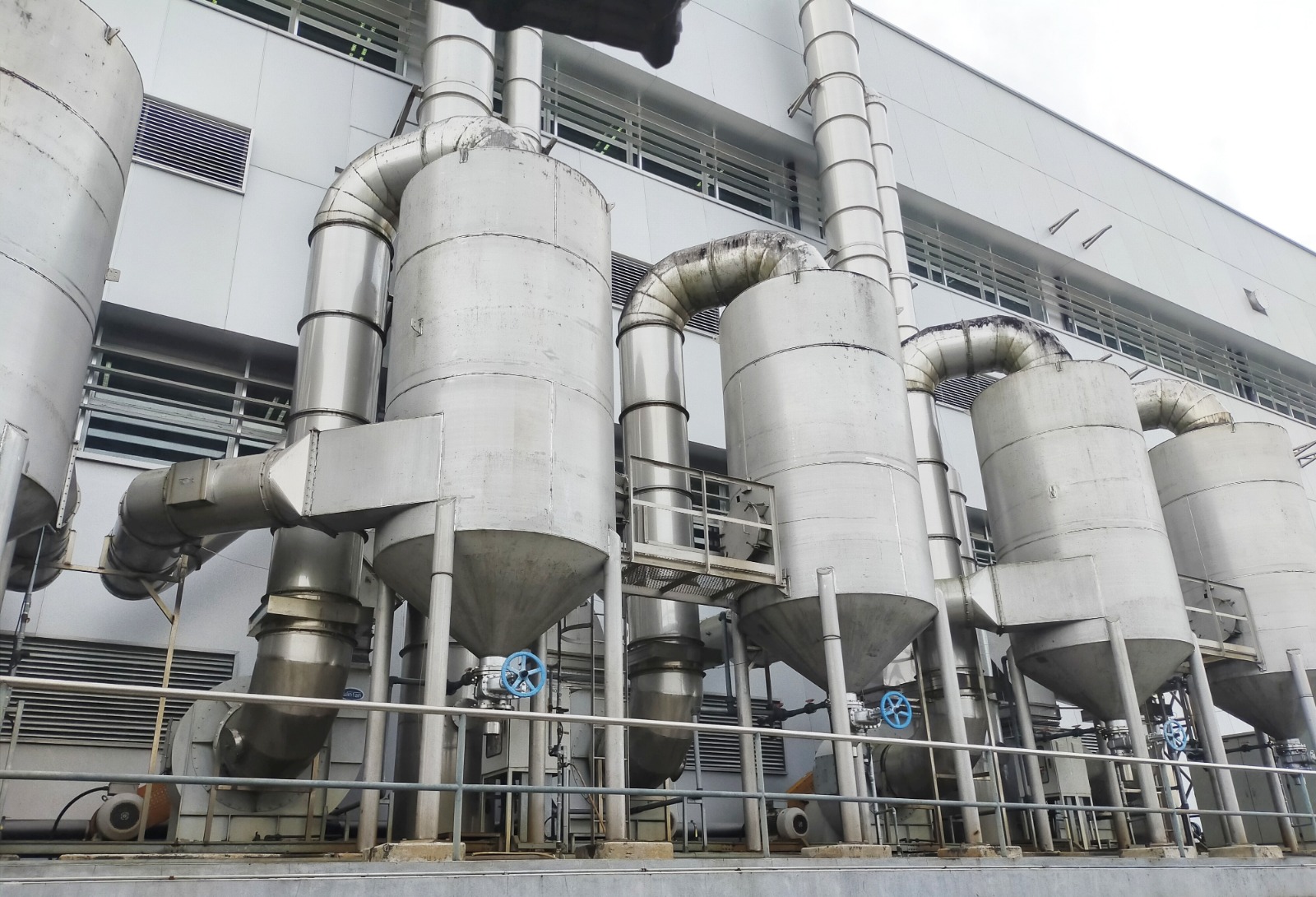
Wet Scrubber is a wet-treatment system that removes particulate, acidic contaminants, and odors from gas streams through liquid contact.

Call Directly

Fast project discussion

Talk to the technical team without waiting for a form

Share capacity, material, temperature, process, and site constraints by phone or email; the team can respond with clear technical next steps.

Wet Scrubber

Wet Collection

DUCON

Product Gallery

Wet Scrubber

7 images
Wet Scrubber
Wet Scrubber
Wet Scrubber
Wet Scrubber
Wet Scrubber
Wet Scrubber
Wet Scrubber

What is a Wet Scrubber?

A wet scrubber is a multi-stage industrial air pollution control device that uses water or neutralizing chemical solutions to remove over 99.9% of acidic gases, heavy particulate matter, and odors from exhaust streams.

  • Working Principle: Dirty gas is driven through a washing tower where high-pressure liquid completely saturates and captures pollutants.
  • High Efficiency: Removes particulate matter and hazardous chemical gases at extreme temperatures where dry filter systems fail.
  • Gas & Odor Treatment: Highly effective for H₂S, NH₃, SO₂, and HCl neutralization in water treatment and chemical process plants.
  • Advantages: Non-clogging open structure, filterless design, low maintenance costs, and high durability under heavy industrial loads.

What are Wet Scrubbers?

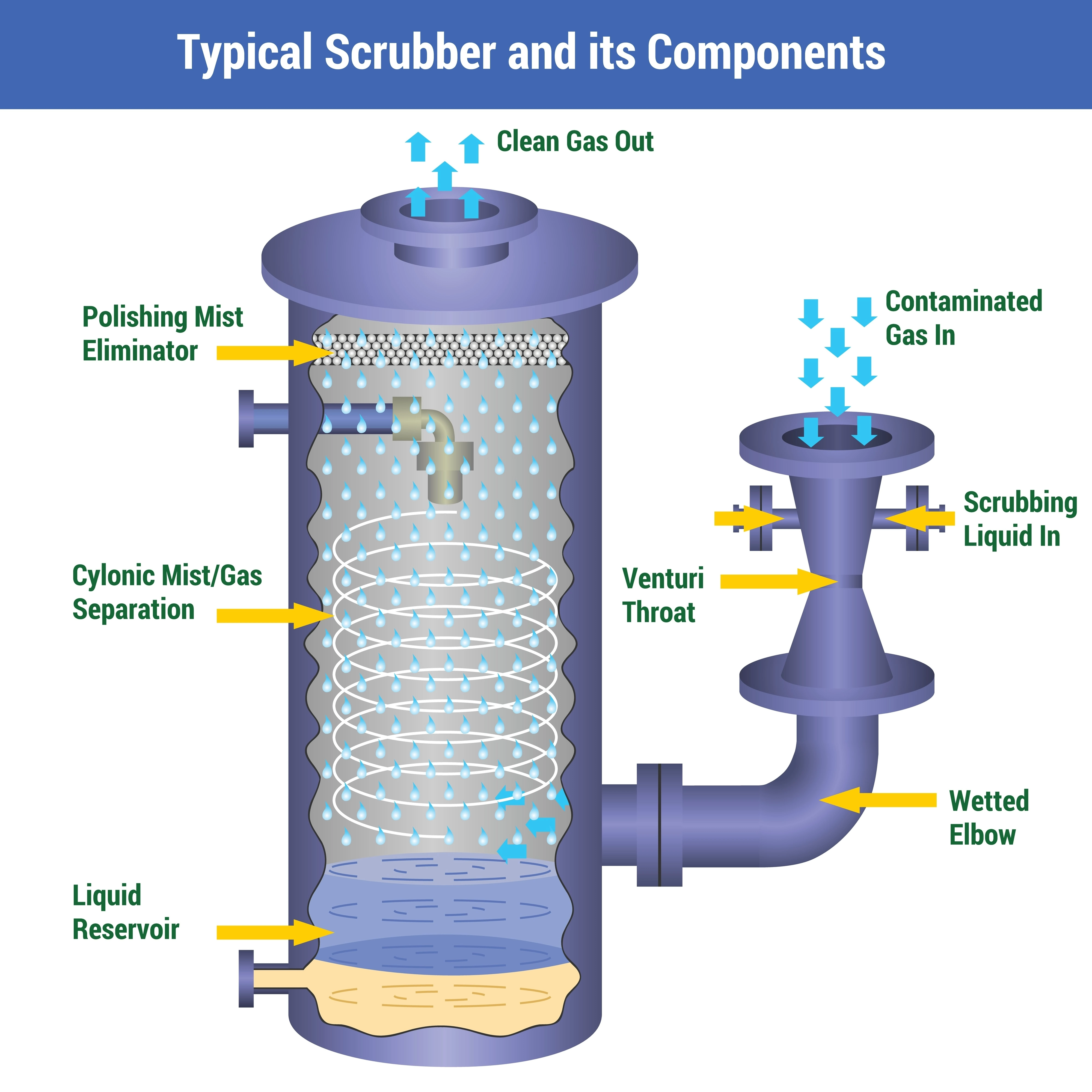
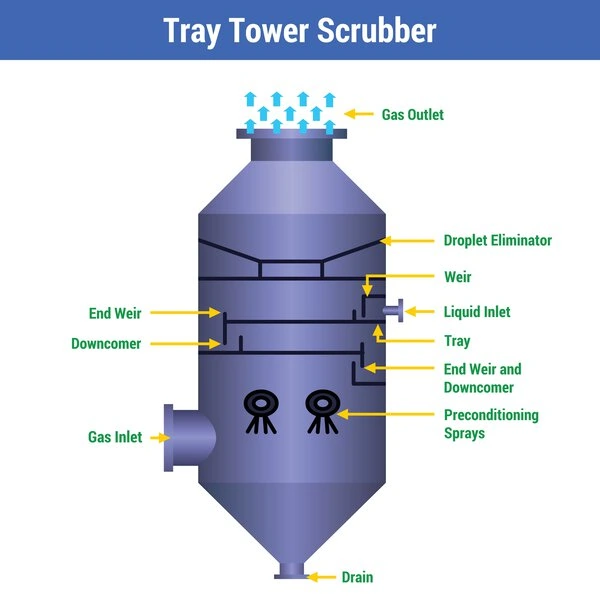
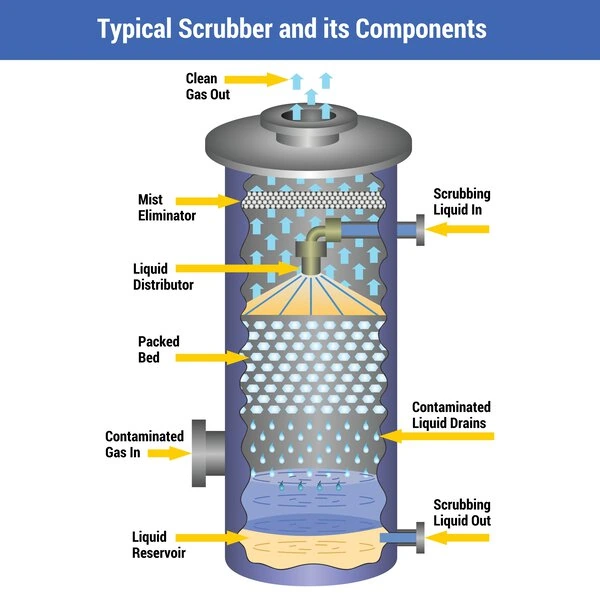
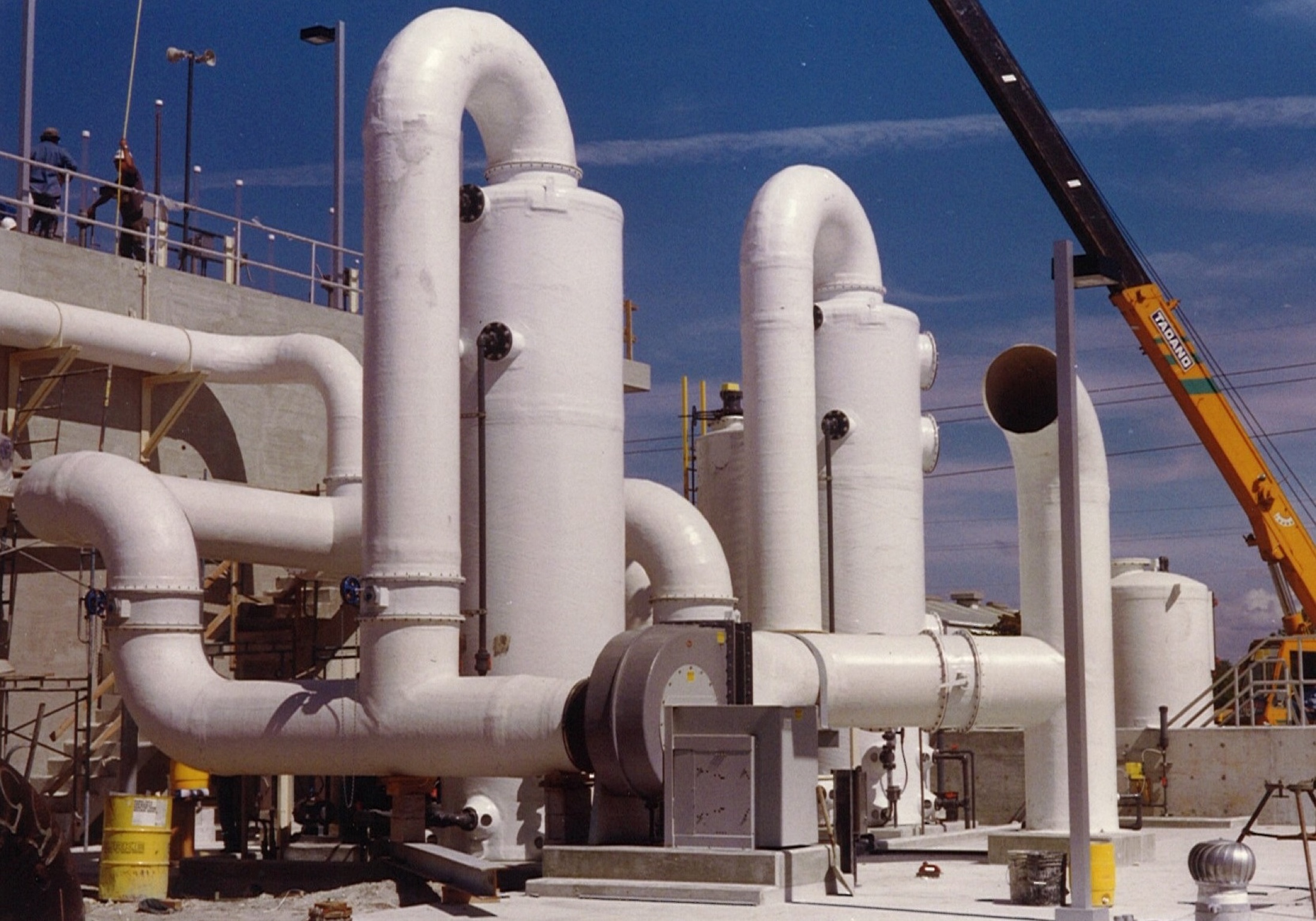
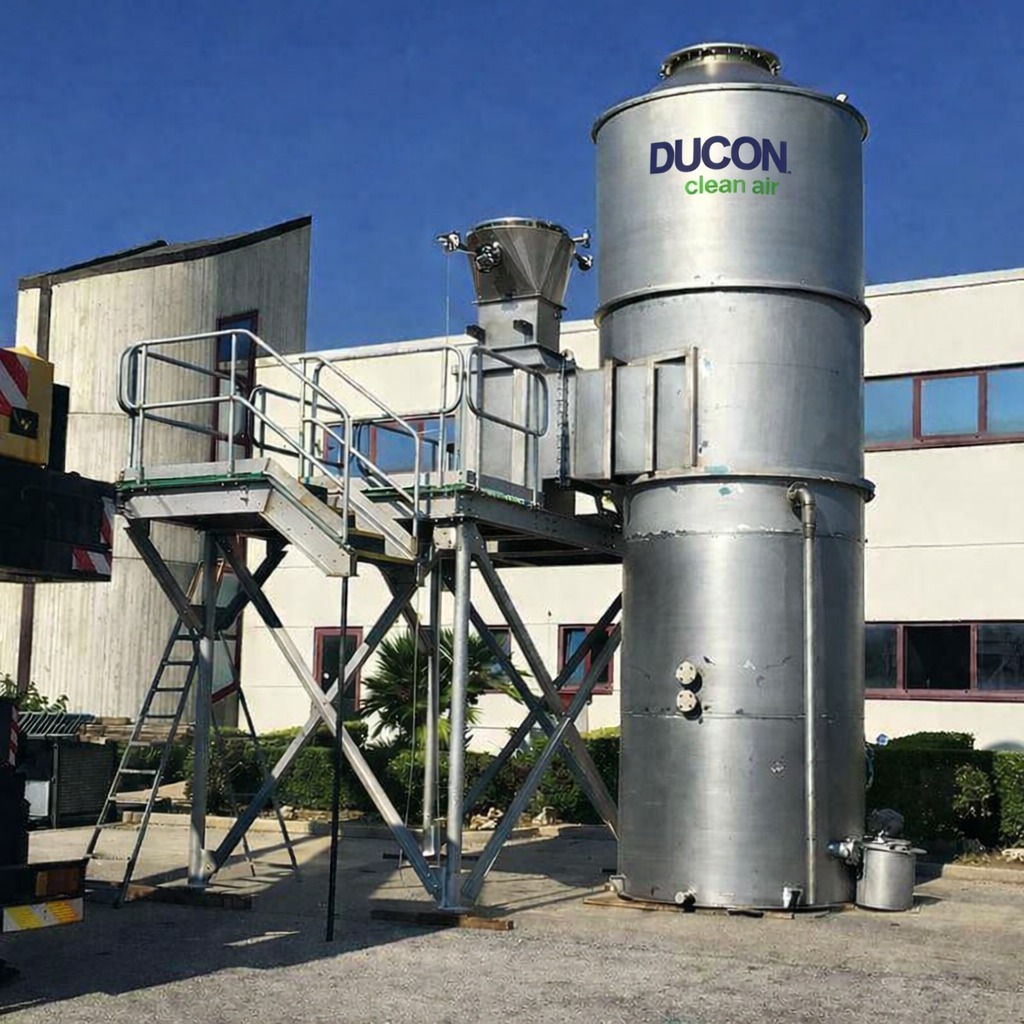
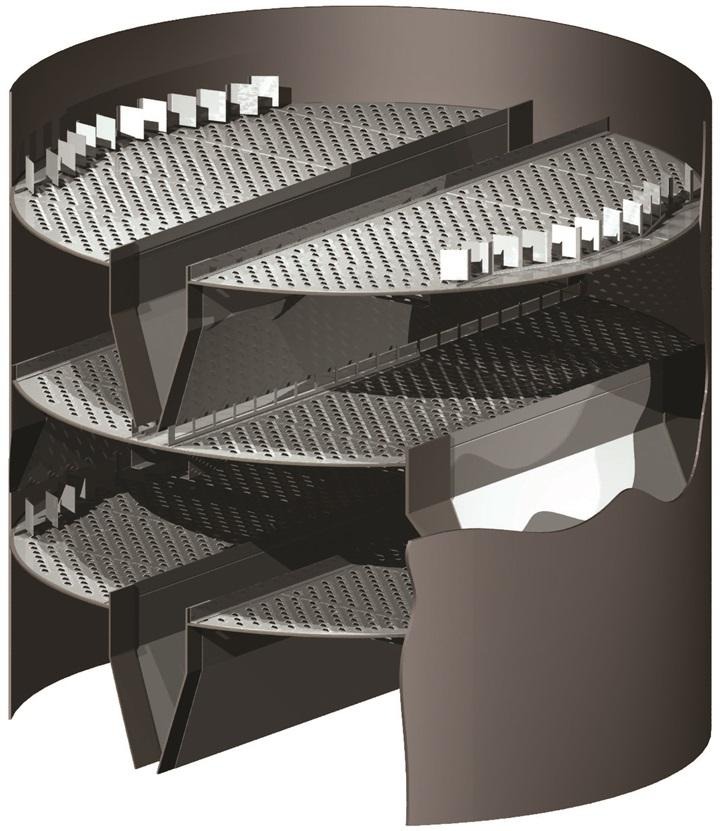
MDSJ Wet Scrubbers use variety of technological configurations to remove particulates and acid gases from exhaust flue gas stream. In a wet scrubber, the polluted gas stream is brought into contact with the scrubbing liquid, by spraying it with the liquid, and forcing it through a pool of liquid, or by some packing media or trays, so as to remove the pollutants. MDSJ Wet Scrubbers are designed to collect particulate matter and/or gaseous pollutants with over 99.99% efficiency and can achieve under 15 m gr/M3 emissions.MDSJ known for its patented dynamic wet scrubbers which include the Dynamic Wet Scrubbers. The MDSJ Dynamic Wet Scrubber is for use in applications involving heavy dust loads, and abrasive materials.
Where heavy dust loads and large particulate have to be removed The Multivane Centrifugal wet Scrubber is particularly suited for applications involving heavy dust loads and large particulate.
Wet Scrubber Applications

Ducon Wet scrubbers provide over 99.9% efficiency on following applications:

  • Black Liquor Recovery Boilers

  • Dissolving Tanks

  • Mining Plants: Particulate control

  • Lime Sludge Kilns

  • Carbon Black Plants

  • Fertilizer Plants

  • Paper Grinding

  • Pelletizing Operations

  • Sintering Plants

  • Ore Dryers

  • Clay Preparation

  • Titanium Dioxide Plants

  • Soda Ash Plants

  • Plastics Handling

  • Phthalic Anhydride Plants

  • Copper Concentrate Dryers

  • Evaportation Vents

  • Bark & Auxiliary Boilers

  • Digester Blow Tanks

  • All Industrial Applications

  • Dyes Manufacture and more.


Ducon Wet DY 3000 Dynamic Scrubber

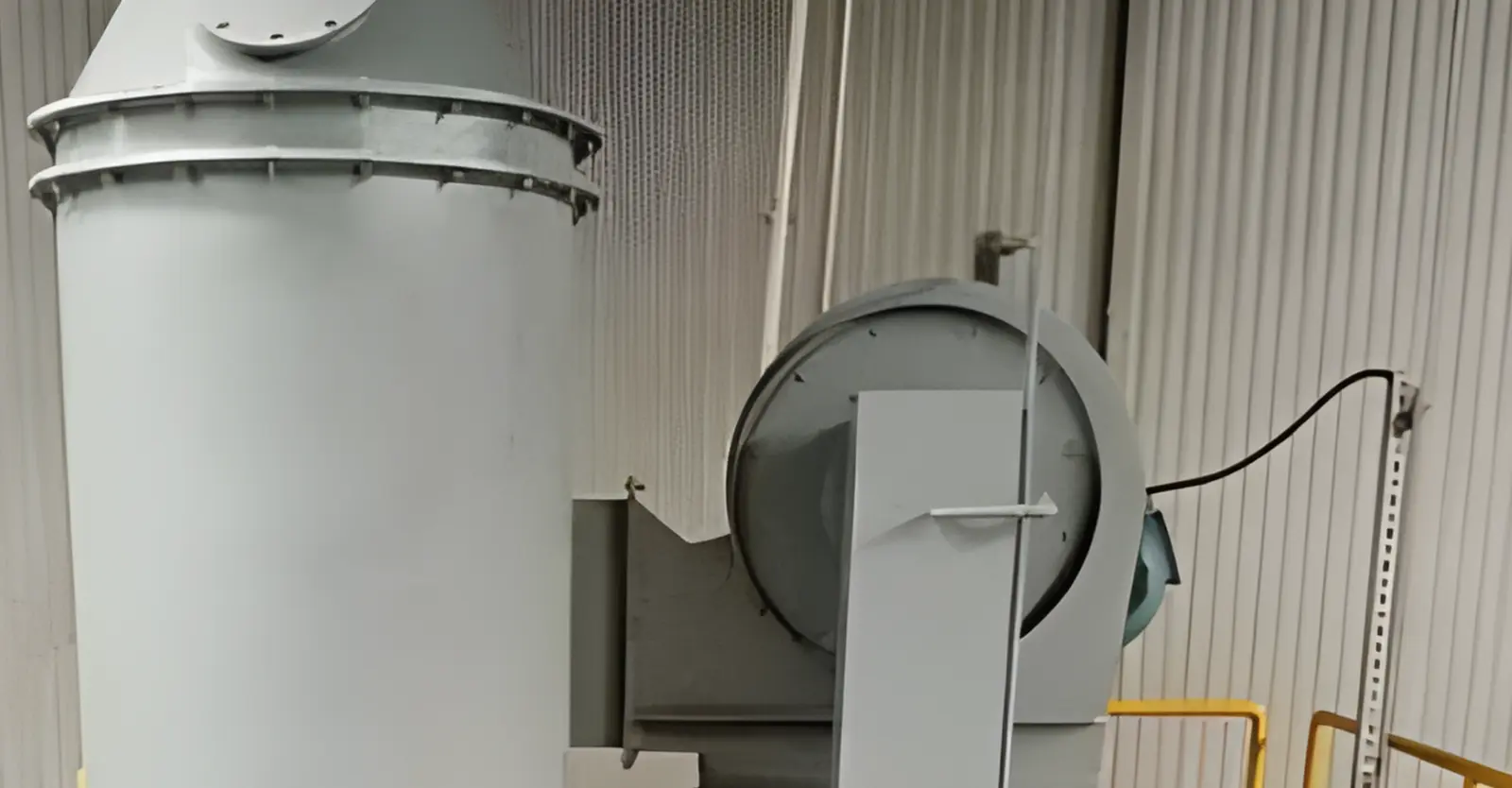
Type DY 3000 This Ducon industrial wet scrubber is compact with built-in wet fan and features dust collection efficiency over 99.9% in minimum space with low water requirements. Rugged construction virtually eliminates maintenance problems.Wet Scrubber DY 4000TYPE DY 4000 This MDSJ Patented DY4000 Wet Scrubber is used for particulate control and is a maintenance free unit, complete with integral wet fan, achieving high efficiency with medium pressure drop in applications involving heavy dust loads, and abrasive materials.

  • Wet Scrubber Advantages99% particulate + collection efficiency in 1 to 3-micron range

  • Achieves 15MGR/M3 outlet loadings

  • Low water rates (2 to 3 gal/1700M3/H

  • Ideal for combined gas absorption and particulate control

  • Integral self-cleaning wet fan

  • Low pressure drop

  • Rugged construction & maintenance-free

  • Multivane Centrifugal Wet Scrubber

The MDSJ Multivane Centrifugal wet Scrubber is particularly suited for applications involving heavy dust loads and large particulate. This unit operates with centrifugal action between gas stream and liquid and can be designed with either spin vanes or spray manifolds for liquid distribution. High efficiencies are obtained for particles in the 2 to 8-micron range.
REQUEST FOR QUOTE

Wet Scrubber Types and Comparison

  • Venturi Scrubber — highest energy contact for fine particulate (PM2.5); high pressure drop, requires larger fan power.
  • Packed Bed Scrubber — best for acid-gas absorption (SO2, HCl, HF, NH3); low pressure drop, polypropylene or PVC packing.
  • Spray Tower Scrubber — low pressure drop, ideal for odor and large particulate; simple design, easy maintenance.
  • Dynamic Scrubber (DUCON DY 3000) — compact and high efficiency; converts mechanical energy into liquid contact.
  • Chemical Absorption (NaOH, Na2CO3) — for toxic gas neutralization; needs pH control and dosing circuit.

Technical Specifications and Capacity Range

  • Gas flow: 1,000 - 500,000 m³/h (DUCON models scaled per application).
  • Operating temperature: -20°C to +200°C (up to 400°C with refractory lining).
  • Efficiency: Venturi 99%, packed bed 95-99%, spray tower 85-92%, dynamic 96-99%.
  • Materials: St37 / 304L / 316L stainless, FRP, PP, PVDF corrosion-resistant linings.
  • Pressure drop: packed bed 15-30 mbar, venturi 40-150 mbar, spray tower 5-15 mbar.
  • Liquid/Gas ratio (L/G): 0.5 - 3.0 L/m³ typical (optimized per application).

Pollutants Removed

  • Acid gases: SO2, SO3, HCl, HF, H2S, Cl2, partial NOx.
  • Basic gases: NH3, amine derivatives.
  • Particulate: PM10, PM2.5, fly ash, dust, mist, sulfuric acid aerosol.
  • VOC and odor: H2S, mercaptans, organic amines.
  • Heavy metals: As, Hg, Pb (gas phase), Cd (application-dependent).

Industries Served

  • Cement and lime — kiln and clinker SO2 / HCl removal.
  • Iron-steel and foundry — pickling, acid wash, foundry furnace emissions.
  • Chemical industry — reactor acid-base gas neutralization, odor control.
  • Waste incineration (MSW, hazardous) — HCl/HF/SO2 and dioxin acid gas removal.
  • Hazardous waste and sulfuric acid plants — end-of-process emission control.
  • Glass and ceramic — kiln stack gas acid and particulate treatment.
  • Food and fermentation — odor and aerosol control.
  • Wastewater treatment — H2S odor control, biofilter pre-treatment.

Selection Criteria

  • Gas flow, temperature, humidity, and contaminant composition should be evaluated together.
  • Pressure drop, liquid consumption, pump load, and mist eliminator design shape the operating cost envelope.
  • Reaction chemistry, pH control, and blowdown handling should be defined early in the design phase.
  • Material selection for corrosion resistance must match the pH and temperature range.

Operation and Maintenance Notes

  • Nozzle fouling, pump-circuit stability, mist eliminator contamination, and corrosion points should be monitored routinely.
  • Liquid recirculation stability and chemical-dosing control are critical to sustained performance.
  • Installations without maintenance access planning typically increase downtime and service cost.
  • Plan for 1 major + 2-4 intermediate maintenance cycles per year.

Why DUCON, Why MDSJ Process?

  • Owner of the DUCON trademark in Europe, Asia, and Turkey — MDSJ Process is the sole manufacturer and service provider under the DUCON brand in this geography.
  • Designing, manufacturing, installing, and commissioning DUCON-brand equipment in Turkey since 1986 — 40 years of continuous industrial project experience.
  • One supplier for three core lines: wet scrubber, jet pulse filter, and pneumatic conveying — one accountable engineering team instead of three vendors.
  • End-to-end project delivery from site survey to live operation: we do not just ship equipment; we own system integration, installation, commissioning, and operator training.
  • Direct trilingual engineering support (TR / EN / DE) — technical documentation in their own language for DACH and European customers operating in Turkey.
  • Field-validated DUCON reference designs across cement, iron-steel, foundry, chemical, pharma, and power-plant projects.
  • Made in Turkey — short lead times, local service, full compliance with Turkish and EU environmental regulations.

Frequently Asked Questions

What is a wet scrubber?

A wet scrubber is an industrial emission-control system that removes particulates, acid/basic gases, and odors from flue gas using a liquid contact medium (water or chemical solution). Efficiency can reach 99%.

What is the difference between venturi and packed-bed wet scrubbers?

Venturi provides 99% efficiency on fine particulate (PM2.5) at the cost of high pressure drop; packed-bed excels at acid-gas absorption (SO2, HCl) with low pressure drop. Choice depends on pollutant type and energy budget.

Which gases does a wet scrubber remove?

Acid and basic gases like SO2, SO3, HCl, HF, H2S, Cl2, NH3, plus PM10/PM2.5 particulate, sulfuric acid aerosol, VOC, and odors.

What is the capacity range of a wet scrubber?

DUCON wet scrubber systems are designed for gas flows from 1,000 m³/h up to 500,000 m³/h. Larger capacities are achieved with parallel modules.

Is there a wet scrubber manufacturer in Turkey?

Yes, MDSJ Process designs, manufactures, installs, and commissions wet scrubbers in Turkey under the DUCON brand (MDSJ owns the DUCON trademark rights for Europe, Asia, and Turkey). Headquartered in Şişli/Istanbul, active since 1986.

When is a wet scrubber better than a dry filter?

Wet scrubbers are more suitable when gas-phase contaminants must be dissolved or neutralized, when humidity or corrosive load is high, or when cooling and scrubbing must happen together.

What is the water consumption of a wet scrubber?

Typical liquid/gas (L/G) ratio is 0.5-3.0 L/m³. Recirculation circuits minimize consumption; only evaporation and blowdown losses are compensated.

What drives wet scrubber operating cost the most?

Pressure drop (fan power), pump duty, liquid consumption, chemical dosing (NaOH/Na2CO3), and maintenance intervals are the main cost drivers.

Is ATEX required for wet scrubbers?

ATEX compliance is required in processes with explosive gases or dust (solvent vapors, alcohol, organic VOC). DUCON systems are optionally produced per ATEX zone classification.

How is a wet scrubber maintained?

Plan for 1 major service per year (internal cleaning, packing check, nozzle inspection) + 2-4 intermediate services (pump, dosing, mist eliminator). Corrosion and fouling points must be monitored continuously.

How long does wet scrubber installation take?

Standard-capacity design + manufacturing takes 8-12 weeks, site installation 2-4 weeks, commissioning 1-2 weeks. Total typical project runs 3-5 months.

Which industries use wet scrubbers?

Cement, iron-steel, chemical, waste incineration, hazardous waste, glass, ceramic, food, fermentation, and wastewater treatment are common application areas.

Quick Info

Up to 99% particulate and acid-gas removal efficiency
Gas and particulate handled in a single integrated system
Venturi, packed-bed, dynamic, and chemical-absorption layouts available

HTML Engineering Resources

Jump to the application page, reference project, and industry series without waiting for a PDF.

Discuss the Project Directly

Share product, capacity, and process details without filling out a form first.

Call Directly Send Email Open the quote form if preferred

Embed This Product

Copy the code below and paste it into your website.

Start a project discussion for this product

Reach the team directly by phone or email; the form is optional.

Call Email