 Türkçe
 English
 العربية
 Deutsch
Pneumatic Conveying System Types and Selection
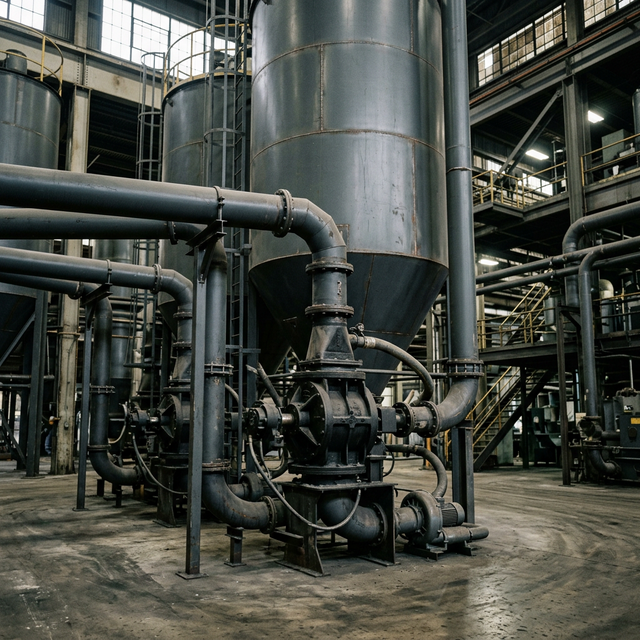
Pneumatic conveying is a clean method that transports powder and granular material through a fully enclosed pipeline on a stream of air, with no spillage and no dust loss. But the root cause of complaints like "we bought a system and now the material is breaking / the pipe is wearing out / it keeps clogging" is usually the wrong system type selection. The most critical decision: dilute phase or dense phase? This guide explains how to select the right pneumatic conveying system for your material.
What is pneumatic conveying?
Material is transported along a pipeline by the pressure/vacuum differential created by an air source (a blower or a compressor). Systems are distinguished along two main axes: by air source (positive pressure / vacuum) and by conveying density (dilute phase / dense phase).
Dilute phase or dense phase? — the most critical decision
| Dilute Phase | Dense Phase | |
|---|---|---|
| Air source | Blower | Compressor (compressed air) |
| Pressure | Low (≤1 bar) | High |
| Air flow rate / velocity | High flow rate, high velocity | Low flow rate, low velocity |
| Material suitability | Robust, non-abrasive | Abrasive, friable, particle size must be preserved |
| Pipe wear | Higher | Low (slow movement) |
Dense phase conveys at low velocity, so there is less impact within the pipeline; material degradation, segregation and pipe wear are all reduced. This makes it ideal for abrasive (sand, clinker), friable (coffee, pasta) materials or those whose particle size must be preserved. Dilute phase, on the other hand, is simple and economical for robust materials that are not prone to wear.
Positive pressure or vacuum?
Positive pressure systems push material from a single source to multiple destinations (silo filling, distribution). Vacuum systems draw from multiple points to a single destination; the risk of dust escape is low, so they are preferred at open dumping/discharge points and wherever hygiene is required. Both can, in turn, be designed as dilute or dense phase.
Critical factors in selection
- Material characteristics: abrasiveness, friability, moisture, flowability
- Conveying distance and height
- Capacity (tons/hour)
- Number of sources and destinations (single/multiple points → positive pressure/vacuum)
- Wear and maintenance cost (over the long term, dense phase can pay off)
Where is it used?
Cement and clinker, food (flour, sugar, grain), plastic granules, fly ash, lime and chemicals. Working in integration with a jet pulse bag filter, it also provides dust control during silo filling. Product families: pneumatic conveying systems, dense phase conveying, dilute phase conveying, vacuum conveying and Denseveyor / Ashveyor solutions.
Frequently asked questions
My material is breaking — what should I do?
In all likelihood it is being conveyed at high velocity in dilute phase. Dense phase (low velocity) significantly reduces breakage and particle degradation.
My pipes are wearing out quickly?
With abrasive material, the high velocity of dilute phase eats away at the pipes. The solution is dense phase plus wear-resistant material at the elbows.
Which system is more economical?
Dilute phase is cheaper in initial investment; but with abrasive/friable material, dense phase's low maintenance plus low waste cost comes out ahead over the long term. The right decision is made through material analysis.
Let's determine the right system together
MDSJ Process has designed, manufactured and turnkey-installed pneumatic conveying systems under the DUCON brand since 1986. Contact us for a free assessment tailored to your material; explore our pneumatic conveying solutions.